

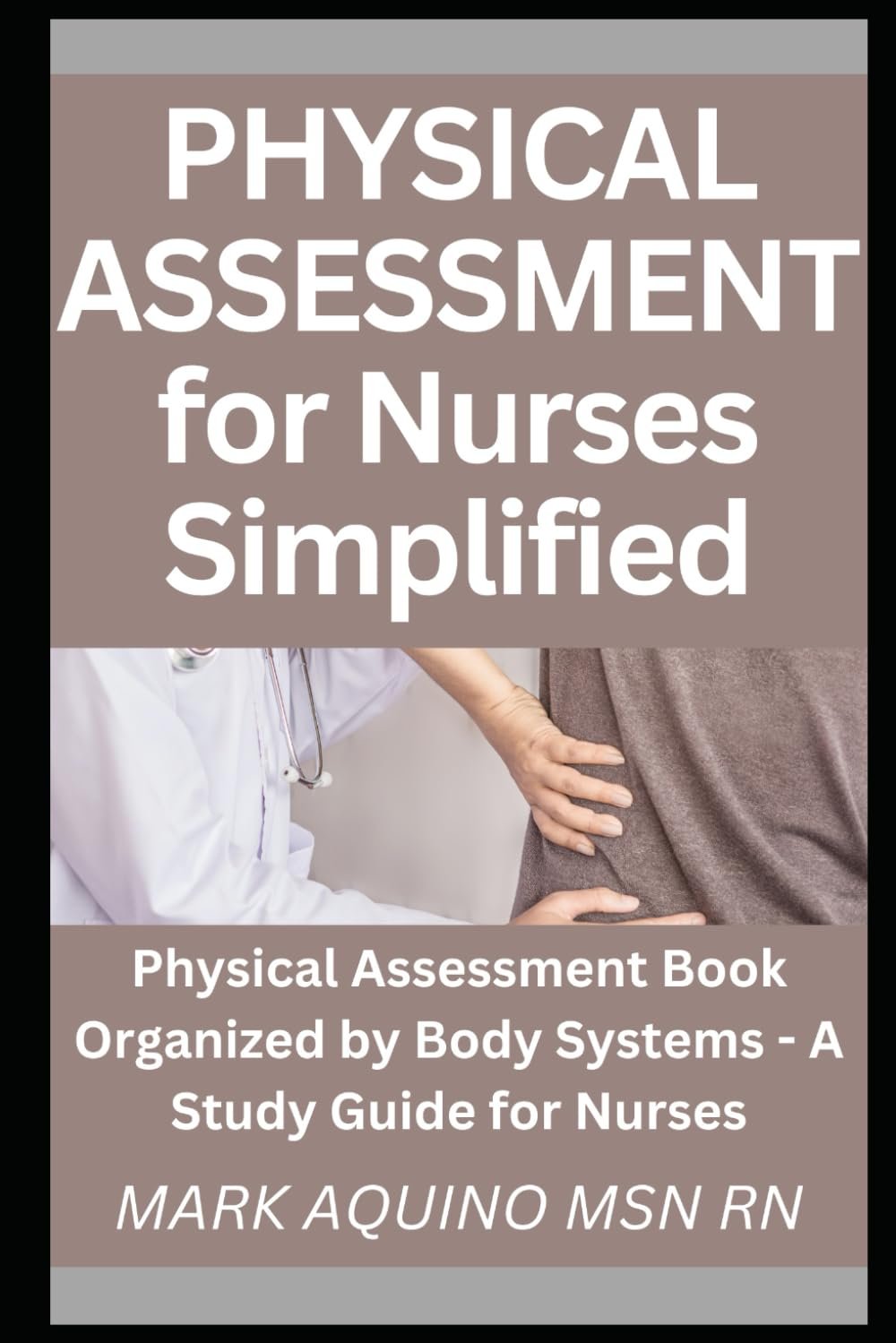
Physical Assessment for Nurses Simplified: Physical Assessment Book Organized by Body Systems – A Study Guide for Nurses (Ninja Series)
$37.99
Description
Price: [price_with_discount]
(as of [price_update_date] – Details)
Buy On Amazon
“Physical Assessment for Nurses Simplified” is an essential guide designed to streamline the learning and application of physical assessments for nurses. Organized according to a 14-point review of systems, this book aligns with the core areas frequently evaluated in patient examinations, making it a valuable educational resource for nursing professionals.
Book Description:
“Physical Assessment for Nurses Simplified” serves as a comprehensive toolkit for both aspiring and experienced nurses, enhancing their capabilities in conducting thorough physical evaluations. This book is meticulously structured to cover all essential aspects of patient assessment through 14 detailed chapters, each dedicated to a specific body system — from general health, skin, and head, to more specialized areas such as the cardiovascular and neurological systems.
Starting with the basics, the book introduces the importance of a detailed physical assessment and provides fundamental techniques and tips on how to effectively use this resource. Each chapter dives deep into specific examination procedures, offering step-by-step guides on techniques, from skin inspection and palpation to advanced cardiac and neurological assessments. This approach ensures that nurses can quickly identify and address various health conditions, recognize early signs of disease, and effectively monitor ongoing issues.
Highlights include:
Detailed chapters on each major body system, providing focused examination techniques and identifying key symptoms and signs.Practical tips on recognizing common disorders and effectively documenting findings.Appendices featuring reference tables for normal versus abnormal findings, quick guides for system assessments, and a comprehensive glossary of terms.
“Physical Assessment for Nurses Simplified” is more than just a textbook — it is a practical guide that prepares nurses for real-world medical settings. The book emphasizes the importance of a systematic approach to physical examination, equipping nurses with the knowledge to perform confident and accurate assessments. This guide is an indispensable resource for anyone in the nursing field, facilitating continuous learning and skill enhancement necessary for high-quality patient care.
Whether you are a nursing student eager to learn the ropes or a seasoned practitioner looking to refresh your physical assessment skills, this book offers the tools you need to succeed in the fast-paced and ever-evolving field of nursing.
Importance of a Thorough Physical Assessment
A thorough physical assessment is integral to the nursing profession. It allows nurses to gather vital data about a patient’s health, aiding in the early detection of diseases, evaluation of the effectiveness of treatment plans, and making informed decisions about further diagnostic tests. The initial assessments provide a baseline against which future changes in a patient’s condition can be measured. This book underscores the importance of precision and attention to detail in the physical examination process.
How to Use This Book
This book is structured to facilitate both learning and practical application in clinical settings. Each chapter focuses on a specific system or aspect of the physical assessment, providing detailed explanations of examination techniques, practical tips, and visual aids to enhance understanding. Readers are encouraged to use this book as a reference guide in their daily practice, as well as a tool for continuous learning. Readers will develop the ability to conduct more comprehensive and effective physical assessments and improve their clinical competence and patient outcomes.
From the Publisher
Are you a nurse who feels overwhelmed when conducting physical assessments? Do you find yourself searching endlessly through dense textbooks or struggling to keep track of every detail in the clinical setting? Physical Assessment for Nurses Simplified is here to turn your anxiety into confidence. This essential guide, organized by body systems, is designed to help you handle patient assessments with precision and clarity, no matter your experience level.
What Makes This Book Your Solution:
· Turn Overwhelm Into Focus – The clear, step-by-step assessment techniques provide a structured framework that cuts through the clutter, letting you focus on what matters most: delivering the best care to your patients.
· Reduce Stress, Gain Control – With quick tips and intuitive organization, you can confidently manage each assessment without second-guessing yourself. Know you have everything you need at your fingertips.
· Clarity in Complexity – Confused by medical jargon or complicated explanations? This book breaks down assessment procedures into simple, digestible steps, giving you the clarity to approach each patient evaluation without fear.
· Bridge the Knowledge Gap – Whether you’re a new nurse or an experienced one, the practical study guide provides real-world clinical scenarios that help you connect theory with practice, ensuring you’re prepared for any patient encounter.
· Exams Made Easier – No more panic studying. The organized, body-system approach helps you easily reinforce and recall critical information, turning exam prep into a smoother, less stressful process.
· Reignite Your Passion for Nursing – By giving you the tools to conduct assessments with ease and compassion, this book helps you focus on the heart of nursing—connecting with your patients and providing quality care.
Feel empowered to deliver the care your patients deserve. Physical Assessment for Nurses Simplified is your key to tackling the daily challenges of nursing assessments with poise and peace of mind. Gain the confidence to navigate patient care smoothly, knowing you have a comprehensive resource that simplifies even the most challenging assessment scenarios.
Introducing: Physical Assessment for Nurses Simplified: Physical Assessment Book Organized By Body Systems – A Study Guide for Nurses
Physical Assessment for Nurses Simplified is the ultimate guide every nurse needs to conduct comprehensive and efficient physical assessments. This indispensable book is meticulously organized by body systems. This book makes it an effortless reference for busy nurses seeking a streamlined approach to patient evaluations. Whether you’re a student building your skills or a seasoned practitioner looking to enhance your assessment techniques, this book has everything you need.
Key Features:
· Step-by-Step Techniques – Each chapter breaks down assessment techniques into clear, actionable steps. It will guide you through every evaluation with precision and ease.
· Organized by Body System – With each chapter devoted to a different body system, you can quickly locate the information you need. No detail is missed during a patient assessment.
· Practical Study Guide – Whether preparing for exams or refining your knowledge, this study guide is perfect for both learning and reinforcing key assessment skills.
· Time-Saving Tips – Filled with quick tips and essential checklists, you’ll learn how to conduct thorough assessments in less time without sacrificing accuracy.
· Comprehensive yet Simplified – Complex assessment techniques are explained in simple, digestible terms, making this book ideal for nurses at all experience levels.
Equip yourself with the tools and knowledge to perform confident, accurate, and efficient assessments. Let Physical Assessment for Nurses Simplified be your go-to resource for delivering outstanding patient care. Whether you’re seeking to sharpen your skills or streamline your study approach, this book is the essential guide to mastering physical assessments with clarity and confidence.
About the Author
Mark Aquino is a registered nurse in California with a Masters of Science in Nursing, Bachelors of Science in Nursing and Masters of Health Administration from West Coast University. He has at worked in various psychiatric and mental health settings working alongside psychiatrists, therapists, and social workers and least 5 years of experience in the front lines as a visiting nurse in home health and hospice care. He is author of OASIS NINJA. A Home Health Nurse’s Guide to Visits, Documentation, and Positive Patient Outcomes. This guide provides nurses with the information they need to provide quality care to their patients in the comfort of their own homes.
Look Inside:

Skin Assessment – Color, Moisture, Integrity, and Lesions
Assessing a patient’s skin is a key part of nursing care, as changes in skin can indicate underlying health issues. Nurses start by looking at the skin color, noting any unusual shades such as pallor (which can suggest anemia), cyanosis (a sign of poor oxygenation), or jaundice (often related to liver problems).
Moisture levels of the skin are also important. Dry skin might be a sign of dehydration or hormonal changes, while excessive moisture could indicate a fever or hyperhidrosis (excessive sweating). The nurse checks for this by gently feeling the skin’s texture.
Next, the integrity of the skin is assessed. This involves looking for any breaks in the skin, like cuts or ulcers, which are particularly important to note in diabetic patients as they can lead to serious infections. Nurses also check for signs of pressure injuries, which are common in patients who are bedridden or have limited mobility.

Vision Screening, External Structures, and Ocular Movements
Vision Screening
The process begins with vision screening to test how well each eye can see. Nurses typically use a Snellen chart where patients read letters from a distance to determine visual acuity. Each eye is tested separately to identify any differences in vision between the eyes. This screening can detect common visual problems like myopia or hyperopia. For patients who already wear glasses or contact lenses, vision is tested both with and without their corrective lenses to assess the effectiveness of the correction.
External Structures
The external examination of the eye includes checking the eyelids, lashes, and surrounding skin for abnormalities such as swelling, redness, or discharge. These symptoms could indicate infections like conjunctivitis or more serious conditions like blepharitis, an inflammation of the eyelids. Nurses also examine the sclera, which is the white part of the eye. It should be clear and bright.

Respiratory Rate, Rhythm, and Effort
Assessing Respiratory Rate
The respiratory rate is the number of breaths a person takes per minute. To measure this, nurses observe the chest rising and falling, counting the number of breaths for a full minute to ensure accuracy. The normal respiratory rate for a healthy adult at rest ranges from 12 to 20 breaths per minute. Rates significantly higher or lower can indicate respiratory or systemic problems. For example, a high respiratory rate might be seen in cases of fever, anxiety, or respiratory disorders like pneumonia or COPD.
Evaluating Respiratory Rhythm
Respiratory rhythm refers to the regularity of breaths. It should be even and consistent. Nurses assess this by noting the timing between breaths to see if it varies. An irregular rhythm, where the pattern of breathing is inconsistent, can be a sign of breathing disorders such as sleep apnea or respiratory muscle fatigue.

Evaluating Pulses
The evaluation of peripheral pulses involves checking the pulse at several key points on the body where arteries are close to the skin’s surface. These points include the radial artery at the wrist, the brachial artery in the upper arm, the femoral artery in the groin, the popliteal artery behind the knee, the posterior tibial artery near the ankle, and the dorsalis pedis artery on the top of the foot.
Nurses palpate these pulses to assess their strength, rate, rhythm, and symmetry. A normal pulse should feel strong and regular. Weak or absent pulses can indicate poor blood flow, often caused by peripheral artery disease (PAD) or a blockage. Asymmetry between the pulses on either side of the body can also suggest vascular abnormalities.
Physical Assessment for Nurses Simplified is crafted for every nurse who wants to excel in conducting efficient, thorough, and accurate patient assessments. Whether you’re a nursing student seeking a clear, no-nonsense guide to help you navigate exams or a practicing nurse looking to refine your skills, this book is designed to meet you where you are. If you find yourself struggling with the overwhelming amount of information in your coursework or feeling lost while trying to recall specific assessment techniques, this guide will be your trusty companion. It’s also ideal for experienced nurses who want a refresher or educators seeking a reliable resource for teaching comprehensive physical assessments.
This book is a comprehensive resource tailored for a variety of healthcare professionals and nursing students who need a structured, practical approach to mastering physical assessments. Here’s who will benefit most from this guide and who might not find it as useful:
Who This Book Is For:
· Nursing Student. This guide is ideal for nursing students who are building their foundational assessment skills. The clear, step-by-step instructions and body system organization provide an accessible framework for learning key techniques and understanding how to apply them.
· Newly Graduated Nurses. New nurses transitioning from the classroom to clinical practice can find this book valuable for reinforcing what they’ve learned, gaining confidence, and understanding how to approach patient assessments with precision.
· Experienced Nurses. Seasoned professionals looking to refine their skills or refresh their knowledge will appreciate the concise summaries, clinical examples, and organized structure that ensure quick and easy reference.
· Nurse Educators. Instructors can use this guide as a dependable teaching resource, incorporating its practical frameworks and detailed explanations into their curriculum to help students understand the importance of thorough patient assessments.
· Nurses Preparing for Certification Exams. For those studying for advanced certification exams, this book provides practical strategies and frameworks that will help them review assessment techniques, identify critical information, and reinforce their knowledge.
Who This Book Is Not For:
· Non-Clinical Healthcare Professionals. Those who are not directly involved in patient assessment, such as healthcare administrators or non-clinical staff, may not find this book useful as it specifically addresses hands-on physical assessment skills.
· Highly Specialized Practitioners. Specialists who require in-depth information on niche areas beyond general physical assessment may find this book too broad in its approach. For instance, cardiologists or dermatologists looking for specialized assessment techniques might need more specialized resources.
· Non-Medical Readers. Individuals outside the healthcare field might not benefit from this book due to its medical terminology and technical focus, which requires a background in nursing or healthcare.
Physical Assessment for Nurses Simplified is designed to be a comprehensive, user-friendly guide that helps healthcare professionals at various stages of their careers refine their patient assessment skills. While it’s not meant for those outside clinical roles or specialized practitioners seeking highly detailed knowledge, it provides an excellent foundation for anyone directly involved in nursing assessment, education, and care.
How This Book Was Made:
Physical Assessment for Nurses Simplified is the product of deep research, practical expertise, and a commitment to making physical assessments accessible for all nurses. The content is built on evidence-based practices and years of clinical experience, ensuring that each technique is reliable, up-to-date, and valuable in a real-world context.
What Went Into Creating This Book:
This book was born out of passion about improving patient outcomes through better assessments. The goal was to ensure nurses feel empowered to deliver exceptional care by having the right tools and knowledge at hand.
Recognizing the challenges new nurses face when moving from the classroom to clinical practice, the book focuses on bridging that gap by including relevant study guides, clinical examples, and practical strategies. These ensure that the book is not just a theoretical resource but one that enhances hands-on skills.
A deliberate effort was made to avoid information overload while ensuring comprehensive coverage. The step-by-step techniques, checklists, and intuitive organization make each chapter easy to navigate, while detailed explanations of why each assessment is important offer crucial insights.
Every detail, from the structure to the layout, was designed to enhance the reader’s understanding and engagement. The authors meticulously ensured that each chapter provides the highest quality information to support nurses in their career journey.
Physical Assessment for Nurses Simplified was designed to be more than just a book. It’s a dependable resource that supports the journey of every nurse, providing practical, easy-to-follow guidance to help nurses master the art and science of physical assessment with confidence and clarity.
Look Inside:

Abdominal Inspection
The first step in the abdominal examination is inspection. Nurses observe the abdomen’s contour, symmetry, and any visible movements. A healthy abdomen typically appears symmetric and smooth. Observing for any bulges, distension, or asymmetrical areas can reveal insights into underlying conditions. For example, localized swelling may suggest tumors or organ enlargement, while generalized swelling could indicate fluid accumulation (ascites) due to liver disease or heart failure. Additionally, the nurse looks for any abnormal pulsations; visible pulsations can sometimes indicate an abdominal aortic aneurysm, especially in older patients.

Signs of Kidney Distress
Various signs can indicate kidney distress, and recognizing these early can lead to better outcomes:
· Changes in Urination – One of the earliest signs of kidney distress involves changes in urination patterns. Patients may notice an increase or decrease in frequency, an urgent need to urinate, or a reduction in volume. Urine may appear foamy, bloody, or very dark, which can indicate the presence of protein or blood.
· Swelling or Edema – Kidneys that are failing to perform properly may not be able to remove excess fluid from the body, leading to swelling in the legs, ankles, feet, face, or hands.
· Fatigue – When kidneys are not filtering toxins efficiently, it can lead to a buildup of impurities in the blood, causing severe fatigue or a general feeling of illness.
· Shortness of Breath – Fluid buildup due to poor kidney function can lead to fluid in the lungs, resulting in shortness of breath.

Assessing Muscle Strength
Muscle strength is typically assessed using a grading system that ranges from 0 to 5:
· 0 (No Movement) – No muscle contraction is detected.
· 1 (Trace) – Muscle contraction is noticeable, but there is no movement at the joint.
· 2 (Poor) – Muscle can move when gravity is eliminated.
· 3 (Fair) – Muscle can move against gravity but not against resistance from the examiner.
· 4 (Good) – Muscle exhibits some resistance against the examiner’s force but less than normal.
· 5 (Normal) – Muscle contracts normally against full resistance provided by the examiner.

Cranial Nerves and Their Functions
Each cranial nerve has a specific role, and assessing these nerves provides clues to their functioning:
· Olfactory (I) – Responsible for smell. Tested by having the patient identify different smells.
· Optic (II) – Handles vision. Tested through visual acuity charts and examining the retina and optic disc.
· Oculomotor (III), Trochlear (IV), and Abducens (VI) – Control eye movements. Assessed by checking pupil size, light reflex, and eye movements.
· Trigeminal (V) – Facilitates facial sensation and muscles of mastication. Tested by facial touch with light stimuli and asking the patient to clench their teeth.
· Facial (VII) – Controls facial expressions and part of taste. Evaluated by asking the patient to smile, frown, and identify sweet or salty tastes on the tongue.
· Vestibulocochlear (VIII) – Affects hearing and balance. Tested through hearing tests and balance assessments.
Physical Assessment for Nurses Simplified is a comprehensive guide designed for a range of healthcare professionals. Nursing students will find it an indispensable tool for understanding and applying assessment techniques crucial for exams and clinical rotations. New graduates can use it to bridge the gap between theoretical learning and hands-on patient care, refining their practical skills and building confidence. Seasoned nurses seeking to enhance their assessment techniques or gain a refresher on specific systems will also benefit from its clear, organized approach. Additionally, nurse educators can integrate the book into their curriculum, offering a reliable and streamlined resource for their students.
How This Book Was Made:
The creation of this book involved multiple stages and relied on collaboration between nurses, medical educators, and healthcare specialists to ensure accuracy, clarity, and practical relevance.
· Clinical Relevance: To ensure applicability, the book includes detailed explanations of assessment techniques, step-by-step guides, and practical tips, all of which reflect the actual challenges nurses face in daily practice. The body system organization ensures readers can quickly access relevant information without sifting through dense material.
· Simplicity and Clarity: Recognizing that medical terminology can often overwhelm, the authors broke down assessment concepts into simplified, step-by-step instructions. The aim was to maintain technical accuracy while making the content accessible to all levels of nursing experience.
What Went Into Creating This Book:
· Passion for Patient Care: The driving force behind this book was the authors’ dedication to improving patient outcomes by empowering nurses with accurate and practical assessment skills. They aimed to make sure each reader could feel confident and knowledgeable while delivering comprehensive patient care.
· Bridging the Theory-Practice Gap:Knowing that theory does not always translate easily to practice, the authors placed special emphasis on providing case studies and study guides that relate directly to clinical scenarios. This ensures that students and new nurses can immediately apply their learning.
· Meticulous Detailing: Each chapter was carefully structured to cover the full scope of physical assessment while keeping the content manageable. Checklists, diagrams, and annotated images were used to aid learning and ensure comprehensive understanding.
Physical Assessment for Nurses Simplified provides a thorough yet accessible foundation for every nursing professional. It ensures that readers can seamlessly navigate patient assessments, bringing clarity and structure to one of the most challenging yet rewarding aspects of nursing care.
This book was created with the philosophy of simplifying and enhancing physical assessments for nurses at all levels of experience. The aim is to address the practical challenges nurses face when conducting thorough patient evaluations, focusing on building confidence, accuracy, and efficiency. Here’s a deeper look into the principles and ideas that guided the development of this book:
Nursing students and new graduates often find the transition from the classroom to clinical settings challenging. The book was created to bridge this gap by providing clear, practical steps that translate theoretical knowledge into real-world clinical skills. Break down assessment techniques into systematic steps and apply what you’ve learned directly to patient care.
Conducting comprehensive physical assessments can be daunting, especially under time constraints and high-pressure situations. The book was made to simplify the process. Nurses get a reliable guide that makes assessment techniques more approachable and systematic. Tips, checklists, and visual aids equip nurses to approach patient care with increased confidence and reduced anxiety.
Accurate physical assessments are important for developing effective care plans and improving patient outcomes. The book emphasizes the importance of a patient-centered approach. Nurses can systematically gather essential information, build rapport, and offer compassionate care tailored to each individual’s needs.
Medical textbooks can often overwhelm students with complex terminology and dense explanations. This resource simplifies these concepts, translating them into digestible, actionable steps that help learners quickly grasp and apply their knowledge.
Healthcare is constantly evolving, and nurses need to keep their skills updated. The book was made to provide both foundational and advanced assessment techniques. Nurses refine their skills and stay current with best practices, whether they’re entering the field or seeking certification.
Time constraints are a reality in clinical practice, but thorough assessments remain essential. The book offers streamlined strategies to conduct comprehensive assessments efficiently without sacrificing accuracy. This ensures nurses can deliver the best care possible within the constraints of their work environment.
Physical Assessment for Nurses Simplified was made with a commitment to making assessment skills accessible and manageable for all nurses. The philosophy behind the book was to provide a resource that could be trusted, easily navigated, and immediately applicable, helping nurses build confidence and competence in providing holistic patient care.
ASIN : B0D3BS9SR3
Publisher : Independently published
Publication date : May 4, 2024
Language : English
Print length : 168 pages
ISBN-13 : 979-8324827281
Item Weight : 11 ounces
Dimensions : 6 x 0.38 x 9 inches
Part of series : Ninja Series
Best Sellers Rank: #328,721 in Books (See Top 100 in Books) #89 in Nursing Issues, Trends & Roles (Books) #151 in Medical & Surgical Nursing (Books) #215 in Nursing Fundamentals & Skills (Books)
Customer Reviews: 4.4 4.4 out of 5 stars 25 ratings var dpAcrHasRegisteredArcLinkClickAction; P.when(‘A’, ‘ready’).execute(function(A) { if (dpAcrHasRegisteredArcLinkClickAction !== true) { dpAcrHasRegisteredArcLinkClickAction = true; A.declarative( ‘acrLink-click-metrics’, ‘click’, { “allowLinkDefault”: true }, function (event) { if (window.ue) { ue.count(“acrLinkClickCount”, (ue.count(“acrLinkClickCount”) || 0) + 1); } } ); } }); P.when(‘A’, ‘cf’).execute(function(A) { A.declarative(‘acrStarsLink-click-metrics’, ‘click’, { “allowLinkDefault” : true }, function(event){ if(window.ue) { ue.count(“acrStarsLinkWithPopoverClickCount”, (ue.count(“acrStarsLinkWithPopoverClickCount”) || 0) + 1); } }); });
Related products
-
- Sale!
- Automotive Accessories
REDTIGER Dash Cam Front Rear, 4K/2.5K Full HD Dash Camera for Cars, Included 32GB Card, Built-in Wi-Fi GPS, 3.16” IPS Screen, Night Vision, 170°Wide Angle, WDR, 24H Parking Mode(F7NP)
- Original price was: $149.98.$85.48Current price is: $85.48.
- Buy Now
-
- Sale!
- Books
HCPCS 2025 Level II Professional Edition (HCPCS Level II (American Medical Assn))
- Original price was: $110.16.$43.30Current price is: $43.30.
- Buy Now
-
- Sale!
- Books
The Body Keeps the Score: Brain, Mind, and Body in the Healing of Trauma
- Original price was: $19.00.$14.39Current price is: $14.39.
- Buy Now




Reviews
There are no reviews yet.